
Optimizing for Google’s AI mode – why ranking #1 is not enough anymore
Google’s AI Mode
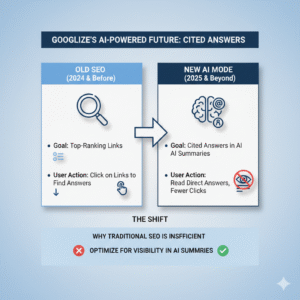 Optimizing for Google’s AI mode in traditional Google search results is no longer the ultimate goal for digital visibility. The rise of Google’s AI Mode (formerly Search Generative Experience or SGE) has shifted the focus from “top-ranking links” to “cited answers”. In 2025 and beyond, AI summaries appear above traditional search results, often answering user queries directly and reducing the need for clicks.
Here is why traditional SEO is insufficient and how to Optimizing for Google’s AI mode-powered future.
Why Ranking #1 Is No Longer Enough
- Visibility Shift: AI Overviews take up significant screen space above traditional blue links, making the #1 organic result often appear “below the fold”.
- Zero-Click Searches: Users now receive direct, summarized answers, causing a significant drop in organic traffic for informational queries.
- Different Evaluation Metrics: AI selects sources based on clarity, structure, and direct answers to user pain points, rather than just backlink strength.
- Traffic Quality: While total traffic may decrease, traffic from AI citations is often higher quality and more likely to convert.
4 Strategies for Optimizing for Google AI Mode
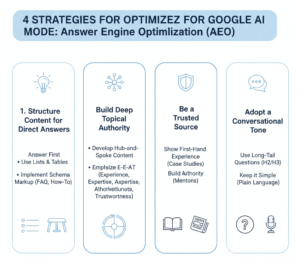 To succeed in the era of Optimizing for Google’s AI mode, SEO must evolve into Answer Engine Optimization (AEO).
-
Structure Content for Direct Answers
Optimizing for Google’s AI mode prefer concise, easily extractable information.
- Answer First: Start sections with a direct definition or answer, then provide context.
- Use Lists & Tables: AI often pulls data from bullet points, numbered lists, and comparisons.
- Implement Schema Markup: Use FAQ, How-To, and Article schema to explicitly tell AI what your content means, enhancing the chance of being cited.
-
Build Deep Topical Authority
Optimizing for Google’s AI mode prefers sources that provide comprehensive coverage over shallow, keyword-stuffed articles.
- Develop Hub-and-Spoke Content: Create pillar pages for core topics and support them with detailed, interlinked subtopic articles.
- Focus on Entities: Clearly define key concepts (entities) in your content to help AI understand the context.
-
Emphasize E-E-A-T (Experience, Expertise, Authoritativeness, Trustworthiness)
Optimizing for Google’s AI mode prioritizes reliable information, especially for YMYL (Your Money, Your Life) topics.
- Show First-Hand Experience: Include case studies, original research, and personal insights.
- Build Brand Authority: Secure mentions in reputable industry publications, as off-site reputation increases citation likelihood.
-
Adopt a Conversational Tone
AI analyses natural language, meaning your content should mirror how users phrase questions.
- Use Long-Tail Questions: Structure headers (H2/H3) as questions that users are searching for, such as “How to…” or “What is…”.
- Keep it Simple: Use clear, plain language that is easy to understand.
Key Takeaways for 2025-2026 SEO
- Rank #1 in AI: The new goal is to be one of the 2-3 cited sources within the AI Overview.
- Monitor Visibility: Use tools like SEMrush or third-party trackers to monitor AI Overview appearances, as Google Search Console data is still evolving for this.
- Keep Content Fresh: AI favors updated, current information over static, aged content.
Comparative Summary of AI Overviews and AI Mode
| Feature | AI Overviews | AI Mode |
| Experience Type | Static summary in Search | Interactive conversation |
| Purpose | Quick insights for everyday queries | Deep reasoning and complex problem-solving |
| Interaction | One-shot answer | Multi-turn Q&A |
| Technology | Gemini 2.0 | Advanced Gemini 2.0 Flash (multimodal, reasoning-driven) |
| Availability | Public in Search | Experimental (Search Labs) |
| Output | Concise overview with citations | Iterative, contextual dialogue |
| Input Types | Text only | Text, voice, images |
| Source Breadth | Limited (single retrieval) | Extensive (multiple retrieval cycles) |
Chat GPT, Perplexity, and Standalone AI Tools
The AI search world includes multiple players with distinct characteristics:
Chat GPT: Uses Bing and Google as Its Indices
 Base Chat GPT models do not maintain their own web index. Instead, they generate search queries and send them to Bing’s API (with evidence suggesting they also pull from Google using SERPs API), retrieve a short list of URLs, then fetch and process the full content at runtime for synthesis.
Key implications: Traditional SEO still matters because Chat GPT relies on existing search rankings to determine which content to retrieve. However, its lack of direct search integration limits depth compared to native platforms.
Bing : Uses Its Index with Chat GPT
 Copilot inherits Microsoft’s full-fledged Bing ranking infrastructure and then layers GPT-class synthesis on top. This creates a two-stage filter where traditional SEO signals determine which candidates make it to the grounding set, while extractability and clarity determine whether those candidates become citations in the final response.
Key implications: Content needs to satisfy both traditional SEO requirements AND AI extractability requirements. Integration with MS365 allows actions beyond search (scheduling meetings, editing documents, etc.).
Perplexity: Uses Bing and Google, Puts Citations in the Foreground
 Perplexity foregrounds its citations, displaying sources prominently and often before the generated answer itself. Like Chat GPT, it doesn’t maintain its own index but pulls from both Bing and Google, generating search queries dynamically and fetching URLs in real-time.
Key implications: The transparency makes Perplexity an excellent “GEO laboratory” for practitioners to reverse-engineer what content characteristics earn citations. However, it operates outside Google’s ecosystem with a significantly smaller market share.