
Develop a strong digital marketing strategy and analyze data to improve performance by at least 45%
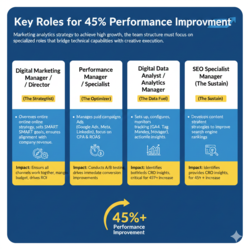
Key Roles for 45%+ Performance Improvement
Marketing analytics strategy to achieve high growth, the team structure must focus on
 specialized roles that bridge technical capabilities with creative execution marketing analytics strategy.
-
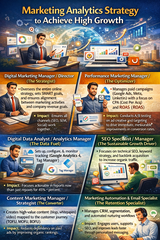
- Digital Marketing Manager / Director (The Strategist)
- Role: Oversees the entire online strategy, sets SMART goals, and ensures alignment between marketing activities and company revenue goals.
- Impact: Ensures all channels (SEO, SEM, Social) work together, manages budget, and drives ROI.
- Performance Marketing Manager / Specialist (The Optimizer)
- Role: Manages paid campaigns (Google Ads, Meta, LinkedIn, ) with a focus on CPA (Cost Per Acquisition) and ROAS (Return on Ad Spend).
- Impact: Conducts A/B testing on ad creative and targeting to drive immediate, measurable improvements in conversion rates.
- Digital Data Analyst / Analytics Manager (The Data Fuel)
- Role: Sets up, configures, and monitors tracking (Google Analytics 4, Tag Manager) to provide actionable insights rather than just reports.
- Impact: Identifies bottlenecks in the customer journey and provides insights for CRO, critical for a 45%+ performance increase.
- SEO Specialist / Manager (The Sustainable Growth Driver)
- Role: Focuses on technical SEO, keyword strategy, and backlink acquisition to increase organic traffic.
- Impact: Reduces dependency on paid ads by improving organic rankings, lowering the overall blended CAC.
- Content Marketing Manager / Strategist (The Converter)
- Digital Marketing Manager / Director (The Strategist)
 Role: Creates high-value content (blogs, whitepapers, video) mapped to the customer journey (TOFU, MOFU, BOFU).
- Impact: Engages users, supports SEO, and improves lead quality.
- Marketing Automation & Email Specialist (The Retention Specialist)
-
- Role: Manages CRM, segmentation, and automated nurturing workflows.Impact: Increases customer lifetime value (CLV) and converts leads faster through personalized messaging.
-
Advantages of this Strategy
- Significantly Improved ROI: Data-driven allocation ensures marketing spend is focused on the most profitable channels.
- Higher Conversion Rates: Personalization and targeted content (buyer personas) can increase engagement by 45% or more.
- Enhanced Customer Loyalty: Personalized, consistent, and relevant communication increases retention.
- Faster Scalability: Identifying successful tactics through data allows for rapid scaling of winning campaigns.
- Increased Brand Visibility: A strong, integrated, and SEO-optimized presence increases search rankings and brand recognition.
- Better Resource Allocation: By focusing on what works and cutting what doesn’t, efficiency increases, leading to higher performance for lower cost.
Disadvantages of an Aggressive 45%+ Improvement Strategy
While aiming for high growth is desirable, pursuing a 45%+ improvement brings significant risks and drawbacks:
- Soaring Customer Acquisition Cost (CAC): To achieve rapid growth, ad spend must increase aggressively. In highly competitive industries, this often leads to a rise in Cost-Per-Click (CPC) and diminishing returns, eroding profitability
Marketing analytics strategy.
- Ad Fatigue & Brand Reputation Risk: Rapid, high-volume advertising leads to “banner blindness” and ad fatigue, where users ignore or dislike the ads. Aggressive, excessive targeting can cause negative consumer feedback, damaging brand reputation
Marketing analytics strategy.
- Intense Resource Demand & Burnout: This strategy requires continuous, daily monitoring, content creation, and technical updates. The intense need to analyze, test, and pivot causes high-pressure environments, often leading to team burnout.
- High Technical Dependency & Risk of Failure: A 45% increase depends on perfect technical execution (fast-loading pages, correct tracking codes, API integrations). Minor glitches, such as broken links or server issues, can cause massive, immediate drops in conversion and revenue.
- Data Overload & Analysis Paralysis: The sheer volume of data produced by advanced tracking can overwhelm teams. Over-reliance on data can lead to ignoring the human element, resulting in sterile, impersonal marketing that fails to connect emotionally.
- Algorithm Volatility: Depending on major platforms like Google or Meta for rapid scaling makes the strategy vulnerable to sudden algorithm changes, which can destroy high-performing campaigns overnight.
Key Challenges and How to Overcome Them
Achieving a 45% increase is difficult due to several industry challenges:
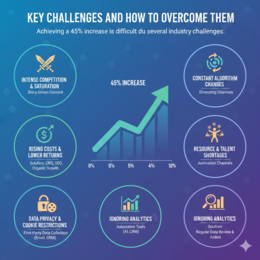 Intense Competition & Saturation: The digital space is crowded.
- Solution: Differentiate your brand with unique, high-quality, story-driven content.
- Rising Costs & Lower Returns: Paid ads are becoming more expensive.
- Solution: Focus heavily on CRO, SEO, and organic, sustainable growth alongside paid strategies.
- Data Privacy & Cookie Restrictions: Less access to third-party data makes targeting harder.
- Solution: Prioritize first-party data collection (e.g., email lists, CRM data).
- Constant Algorithm Changes: Google/Social media updates can disrupt traffic overnight.
- Solution: Diversify marketing channels to reduce reliance on a single platform.
- Resource & Talent Shortages: Teams are often stretched too thin to execute complex strategies.
- Solution: Streamline workflows using automation tools (AI, CRM tools) to free up time for strategic planning.
- Ignoring Analytics: Failing to review data regularly means guessing instead of acting.